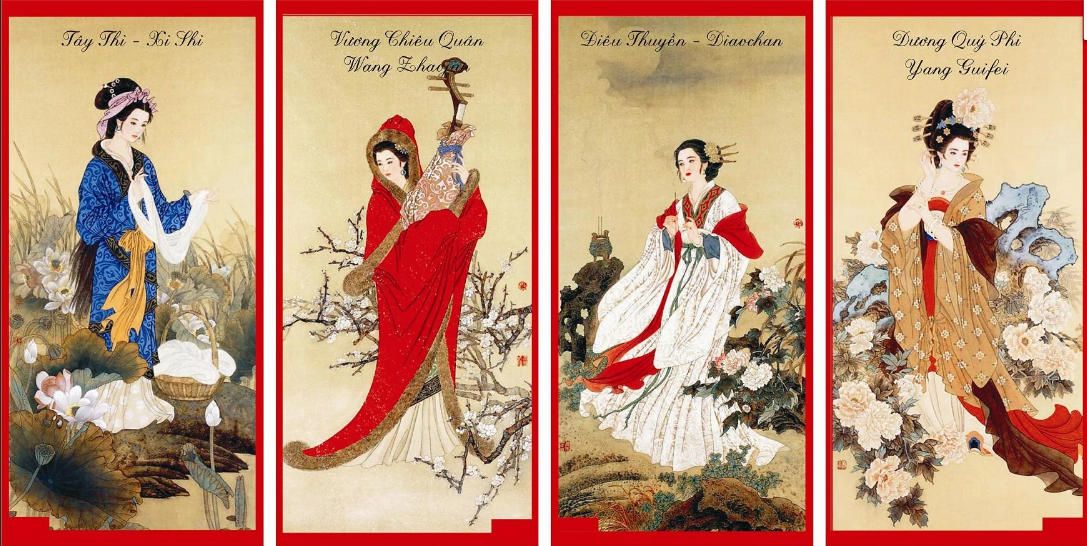
Four Great Beauties
Introduction
The term "Four Great Beauties" refers to four legendary women from ancient China, renowned for their exceptional beauty and significant influence on Chinese history and culture. These women are Xi Shi, Wang Zhaojun, Diao Chan, and Yang Yuhuan, each associated with captivating stories and historical events. Their tales have been passed down through generations, embodying the essence of beauty, intelligence, and sacrifice.
Xi Shi
Xi Shi, often considered as the foremost among the Four Great Beauties, lived during the Spring and Autumn period (770–476 BC). She is famously linked with a story of espionage and diplomacy. Xi Shi was from Zhuji, a scenic city in present-day Zhejiang province. Her beauty was said to be so enchanting that, according to legend, fish would forget how to swim and sink upon seeing her reflection.
Xi Shi played a pivotal role in the conflict between the states of Wu and Yue. The King of Yue, Goujian, after being defeated by the King of Wu, Fuchai, plotted revenge. Xi Shi was sent to the Wu court as a part of this plan, where her beauty captivated Fuchai, distracting him from his duties and leading to the eventual downfall of Wu. This story highlights the strategic use of beauty and intelligence, and Xi Shi's name remains synonymous with grace and allure.
In modern times, her story has been celebrated in various forms, including ballet productions such as Suzhou Ballet's Legend of Beauty, which dramatizes the ancient Wuyue culture while blending Eastern aesthetics with Western music.
Wang Zhaojun
Wang Zhaojun was a beautiful woman during the Western Han Dynasty (206 BC – 24 AD). She is best known for her marriage to the leader of the Xiongnu, a powerful nomadic tribe, as part of a political alliance. Wang Zhaojun's sacrifice in leaving the imperial court for the borderlands helped to secure peace between the Han Dynasty and the Xiongnu for decades.
Her story is one of cultural exchange and diplomacy, where her personal sacrifice played a crucial role in maintaining harmony and stability. Wang's tale has been adapted into various art forms, including dance dramas like Princess Zhaojun, which brings her story to life on stage, celebrating her legacy as a symbol of peace and unity.
Diao Chan
Diao Chan, a fictional character from the historical novel Romance of the Three Kingdoms, is traditionally included among the Four Great Beauties. Although her existence is debated, Diao Chan's story has become an integral part of Chinese cultural lore. She is depicted as a master of intrigue and manipulation, whose beauty and wit were instrumental in dismantling the power of the tyrannical warlord Dong Zhuo.
Her tale is a testament to the influence of women in historical narratives and their role in shaping political landscapes. Diao Chan's story, filled with drama and intrigue, continues to inspire adaptations in literature, theater, and film, demonstrating her enduring impact on Chinese culture.
Yang Yuhuan
Yang Yuhuan was a consort of Emperor Xuanzong during the Tang Dynasty (618–907). Her beauty was legendary, and she became one of the emperor's favorite concubines. Yang Yuhuan's life story is marked by luxury and romance, but it also ends in tragedy, as she was blamed for political turmoil and ultimately executed during the An Lushan Rebellion.
Her story is a reflection on the interplay of love, power, and politics, illustrating how personal relationships can influence state affairs. Yang Yuhuan's legacy is preserved in poetry, music, and dance, including performances like "Li Bai," which explore the cultural and artistic milieu of the Tang Dynasty, highlighting its aesthetic richness.
Cultural Legacy
The Four Great Beauties have left an indelible mark on Chinese culture, symbolizing the profound impact of beauty intertwined with intelligence and political acumen. Through their stories, these women have influenced artistic expressions, from traditional opera and dance dramas to modern ballets and theatrical performances. Their legacies continue to resonate, offering timeless tales of beauty, strategy, and sacrifice that enrich China's cultural heritage.








